
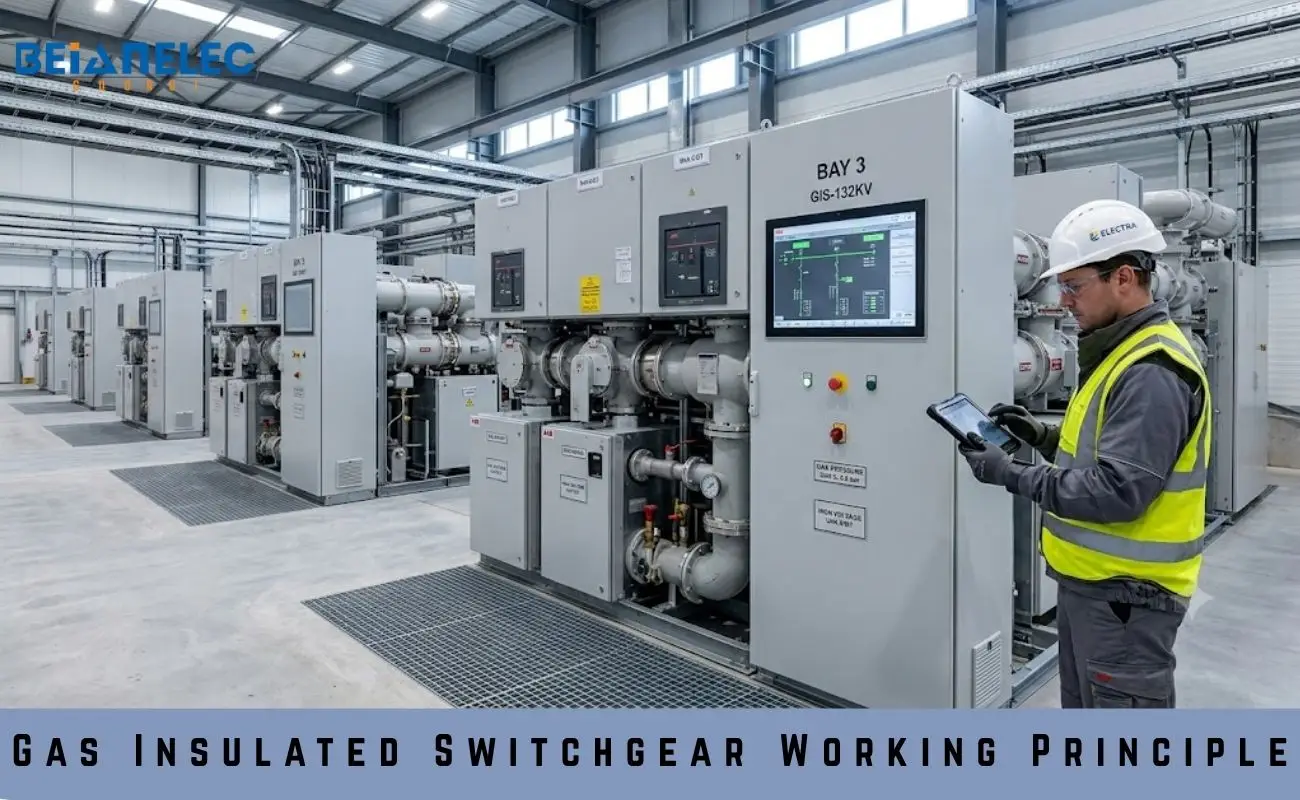
Gas insulated switchgear working principle is very important to understand in electrical manufacturing. It uses gas to fill metal compartments that contain circuit breakers, busbars, disconnect switches, and similar components. The gas helps support better insulation compared to air. Using air-switched components allows a smaller design that makes GIS more compact
It combines insulation with the ability to switch and isolate components to support the reliable distribution of electrical power. The sealed nature of the construction lets GIS components be used in a variety of locations with limited space and makes the components operate more consistently.
What Gas Insulated Switchgear Is?
Structuring an electrical system that involves circuit breakers, disconnect switches, and busbars within sealed cabinets that are insulated by gas, is known as gas insulated switchgear (GIS ). These systems have particularly good insulation and arc extinguishing and so are with great advantage used in medium and high voltage electrical power systems.
Gas insulated switchgear applications are commonly found where space is a constraint or in systems with challenging environmental conditions. Also they are used in gas insulated substation thanks to previous characteristics.
Why GIS Uses SF6 Gas?
Gas insulated switchgear working principle depends on SF₆ Gas due to its:
- Notable insulative strength: In compact designs, SF₆ maintains high voltage supportive insulative strength.
- Greater arc extinction: Disrupts sustained electrical arcs in the course of switching further.
- Compact design: Reduces space needed for switchgear and its installation.
- High reliability :SF₆ serves GIS under a broad temperature range without control loss.
- Moisture resistant: Protects internal mechanisms from bush contamination.
- Long lifetime: Supports extended low-maintenance GIS in service.
Read More : Gas Insulated Switchgear manufacturer
What is gas insulated switchgear working principle
The gas insulated switchgear working principle – or SF6 switchgear- is based on the use of integrated gas insulation for power distribution which is safe, compact, and reliable.
- Gas insulation: gas insulation consists of SF₆ or environmentally friendly gas which has excellent dielectric strength.
- Sealed enclosure: Metal compartments prevent live electrical components from being exposed to the elements.
- SF6 arc quenching: In the case of a fault, circuit breakers interrupt the arc in the insulating gas.
- Power distribution: Busbars connect different sections of the switchgear for the distribution of electricity.
- Circuit isolation: Disconnect switches provide a means of isolating the equipment for maintenance.
- Fault protection: protection relays monitor the system for abnormal conditions and energize the circuit breakers.
- Grounding function: Earthing switches provide a means of discharging the isolated circuits to ground prior to maintenance being performed on the system.
Why GIS Is More Compact Than AIS ?
By using high-performance gas insulation systems and integrated component designs, GIS achieves footprints that are 30% or smaller than those of AIS.
- Compact Design: The elements in GIS are in sealed, compact enclosures.
- Integrated Design: GIS combines breaker, bus, and switch functions in unitary, modular systems.
- Space Efficient: The compact design GIS systems are ideal for use in urban and indoor substations.
- Less Environmental Exposure: No large air insulation distances are required.
- Flexible Layouts: Simplified modular construction design is especially useful for restricted spaces.
- Smaller Land Requirements: Reduced substation footprint translates to reduced overall cost of substation and its infrastructure.
Read More : Electrical distribution switchgear systems from Beianelec
What is the difference between GIS and AIS?
Gas insulated switchgear working principle makes a big differences versus air insulated switchgear
The following table explain the main differences between gas insulated switchgear vs air insulated switchgear
| Feature | Gas Insulated Switchgear (GIS) | Air Insulated Switchgear (AIS) |
| Typical Applications | Urban substations, industrial plants, and indoor installations | Outdoor substations, utility networks, and large open sites |
| Insulation Medium | Uses SF₆ or environmentally friendly insulating gas | Uses ambient air as the insulating medium |
| Installation Space | Requires a compact installation footprint | Requires a larger installation area |
| Maintenance | Lower maintenance due to sealed construction | Higher maintenance because components are exposed |
| Environmental Protection | Excellent resistance to dust, moisture, and pollution | More affected by environmental conditions |
Read More : Top Switchgear manufacturers in China
What are the disadvantages of gas insulated switchgear?
Although gas insulated switchgear advantages are various, there are some disadvantages of using GIS.
- Cost: GIS pricing can be higher than vacuum and air insulated switchgears.
- Maintenance: GIS requires highly skilled technicians, which increases lifetime costs. GIS cannot be serviced without specialized tools.
- Gas: GIS uses SF₆ gas, which can be a danger when used in high voltage environments.
- Environmental impact: GIS can have an impact on the environment during SF₆ leaks.
- Faults: Damaged GIS components can be difficult to replace and are expensive.
- Gas density: Failure in the monitoring of gas density may impair the performance of the system.
- Modifications: GIS systems have low flexibility, which can be an issue if modification of the system is required.
- Repairs: GIS malfunction is costly. Frequent maintenance and monitoring can mitigate this.
How long does gas insulated switchgear last?
With the right design, installation, operations, and maintenance, Gas Insulated Switchgear (GIS) can last up to 40 years. The reliable long-term performance of GIS integrates the quality of the gas insulated switchgear components, the buildings’ sealed construction, and the efficiency of the insulation.
The longevity and safe and reliable operation of GIS systems can be achieved through servicing the system and performing routine inspections, gas density checks, and functional tests.
Why Beianelec considered the best gas insulated switchgear manufacturer ?
Beianelec is renowned for providing solutions for gas insulated switchgear that are trustworthy, thanks to their dedication to the profession, their meticulous inspection processes, and their customer-orientated support for cutting-edge power distribution.
- Cutting-edge manufacturing: Ensures quality in every product.
- Designed to IEC standards: International standards are catered for in the product design.
- Thorough testing: Stringent inspections are performed on all GIS units.
- Assured operation: Safety, reliability, and long-life are designed into the product.
- Bespoke solutions: Project-oriented design flexibility.
- Innovative solutions: GIS technologies that are compatible with digital and intelligent grids.
- Expert technical assistance: Support from the design and engineering stage to the end of the placement and maintenance services.
- Worldwide project support: Applicable to utility, industry, and commerce.