 Skip to content
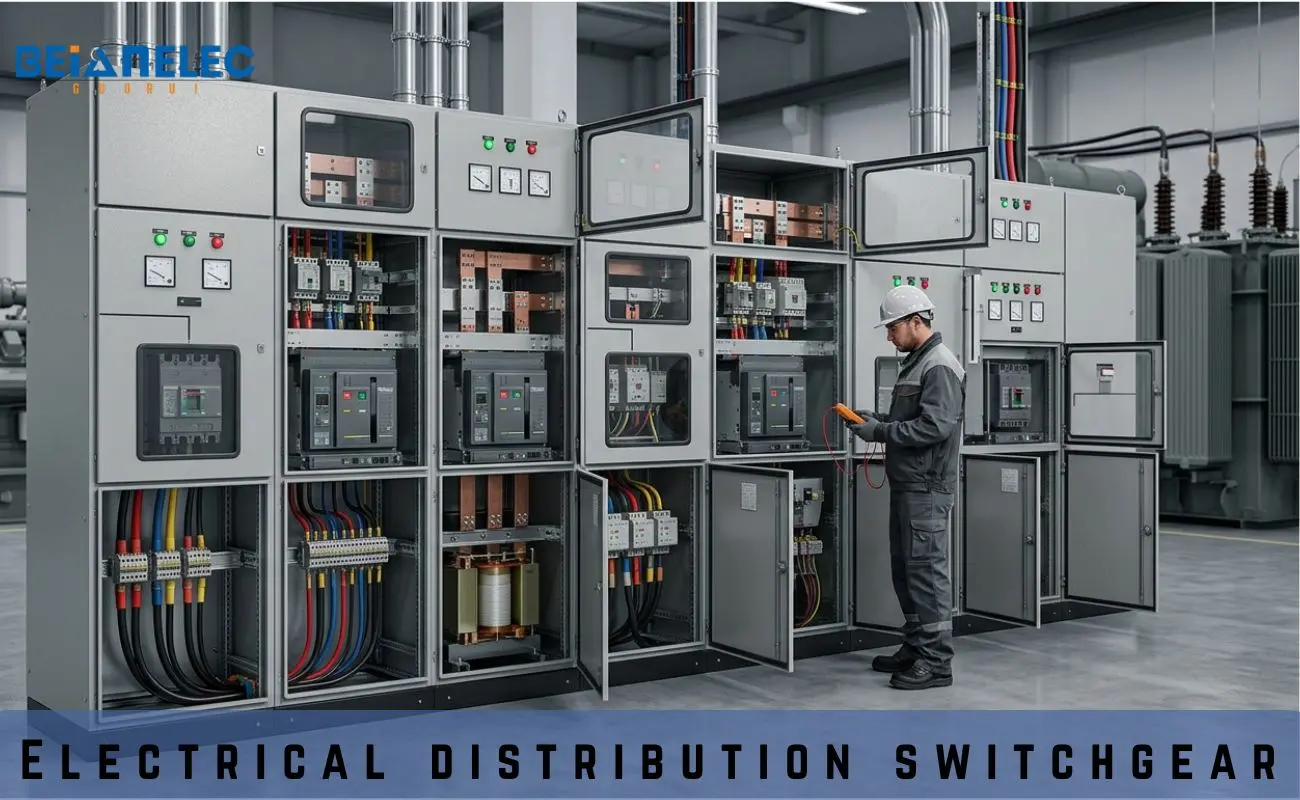
Electrical distribution switchgear is one of the essential components in the power distribution network. It has the devices and components that control, protect, and separate circuits and equipment. Devices include circuit breakers, disconnect switches, relays and fuses, busbars, and other devices that allow the safe and effective distribution of power in the industrial, commercial, and utility sectors.
Switchgear is used to stop electrical faults by disconnecting the section of the network that is affected. Smart power distribution switchgear is designed to include features of monitoring, automation, and increased reliability for operations. This makes modern distribution switchgear a necessity for the electrical network.
What is electrical distribution switchgear ?
Electrical distribution switchgear is an integral part of power distribution systems. It combines control, protection, and isolation of electrical circuits alongside devices such as circuit breakers, switches, relays, and fuses. These help prevent incidents such as overloads and short circuits and help protect against electrical faults. They can be installed in industrial and commercial applications as well as utility applications.
Electrical distribution switchgear help power systems remain operational safe and stable. From substations to factories and commercial buildings, and almost in every infrastructure project with continuous and controlled electrical distribution, power distribution switchgear can be found.
How Distribution Switchgear Protects Your Electrical Infrastructure
Switchgear systems can control the flow of electrical power to help protect the electrical system from fault conditions while allowing the system to bed safe and operational.
- Faults are quickly isolated by disconnecting affected systems to help protect equipment.
- Protective systems help prevent damage to electrical systems from excess current.
- Fault protection systems help detect and interrupt excessive currents that can be damaging.
- Protective systems help prevent employees from contact with electrical systems and help reduce the potential for an arc flash.
- Protective systems maintain the stability of the power distribution system.
- Protective systems help prevent damage to electrical equipment.
Read More : How to Choose the Best Cast Resin Transformers Manufacturers
The Main Components of electrical distribution switchgear
Electrical distribution switchgear comprises components that conduct, control, and manage electrical energy in a predictable and safe manner. They include:
- Circuit breakers: Break and protect electrical equipment from fault currents.
- Disconnect switches: Are used to isolate circuits for maintenance and for safety.
- Protection relays: Are used to sense abnormal and out-of-range conditions.
- Busbars: Move electrical power from the incoming feeders to the outgoing feeders.
- Fuses: Break the circuit that experienced a fault.
- Metering instruments: Serve to capture and record the voltage, current, and the status of the system.
Read More : Choosing Commercial Electrical Transformer
Types of Electrical Switchgear in power distribution system
The types of electrical switchgear vary depending upon the level of voltage, the method of insulation, and the numerous applications in the power system.
- Low voltage switchgear: is applied to systems that are less than 1 kV in commercial and industrial applications.
- Medium voltage switchgear: used from 1 kV to 36 kV in the distribution systems.
- High voltage switchgear: is applied to transmission systems that are above 36 kV.
- Air-insulated switchgear (AIS to use air is used as the insulating medium.
- Gas-insulated switchgear (GIS) to use SF6 gas is used to achieve a compact and reliable insulation.
The Evolution of Smart Switchgear in Modern Power Distribution.
With automation, smart technologies, and digital systems, smart primary distribution switchgear encourages reliability and efficiency in operational systems and transforms modern electrical distributions.
- Control and diagnose: Achieved through centralized remote management.
- Fault detection predictive analysis: Identifies and predicts failure.
- Increased safety: Automatic protection systems minimize arc flash.
- Power management efficiency: Improves system efficiency.
- Modern digitally automated systems supported: Integrated smart grids.
Read More : Top Switchgear manufacturers in China
The Role of Circuit Breakers and Disconnect Switches in Distribution.
Circuit breakers play an important role in the electrical distribution system to keep its components safe and effective.
- Fault protection: Safeguards system components and helps control system stability.
- Disconnect switches: Enable the isolation of electrical circuits for service and maintenance.
- Operational safety: Ensures that personnel are protected via visible isolation of circuits.
- System control: Allows the safe switching and sectionalizing of electrical systems.
- Reliability improvement: Helps reduce downtime and allows for uninterrupted power distribution.
Common Failures in Electrical Switchgear and How to Prevent Them.
There are many common failures that may occur if required protection or maintenance are provided
- Overheating – Caused by poor load management and thermal overload causing excessive heating of loose connections. Prevented by thermal inspections and appropriate load management.
- Arc flash faults are caused by internal faults and poor maintenance. Can be reduced by using arc flash resistant designs and arc gap protective relays.
- Mechanical fatigue is caused by switching the equipment. Can be prevented by the regular maintenance of the equipment and proper lubrication.
- Corrosion and contamination caused by dust and humidity. Can be prevented by the proper sealing of the enclosure and control of the environment.
- Protection relays malfunction when improperly set retards fault response and can be prevented by regular calibration and functional tests.
FAQs
What is the difference between switchgear and a switchboard?
Switchgear is used to protect, control and isolate the equipment from medium and high voltages when electrical faults occur. A switchboard is a low voltage electrical power distribution system with breakers, switches and protective devices built within an enclosure.
How often should distribution switchgear be inspected?
At least every six months, distribution switchgear must be visually examined. Detailed testing and preventive maintenance are suggested to be performed every 1-3 years for distribution switchgear depending on its usage (operational conditions, load, and environment) as well as what the manufacturer suggests.
How do environmental conditions affect switchgear performance?
Wear of electrical switchgear insulation can result from various environmental conditions, such as excessive moisture, dust, heat, pollution, and even corrosion. This can also cause equipment to overheat and result in premature aging of the equipment.
