
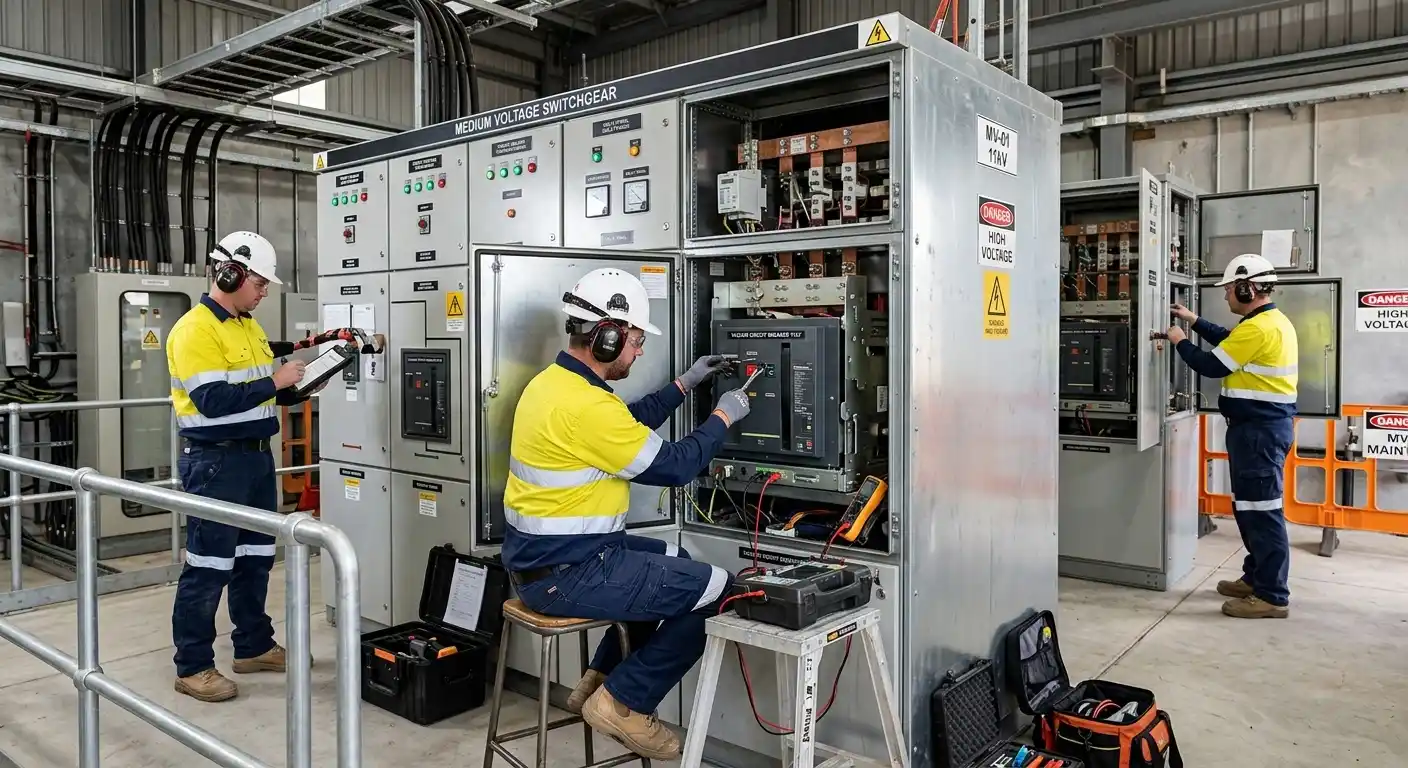
Medium Voltage Switchgear maintenance is critical for safe, reliable, and efficient distribution of electricity. It allows detection of wear, degradation, loose connections, and breakdowns which enables actions to prevent costly outages and damages to equipment. Well-maintained switchgear equipment in industrial, commercial, and utility settings also increases safety and equipment lifespan.
Regular maintenance involves a number of activities such as visual inspections, maintenance cleaning, insulation tests, thermal scans, mechanical tests, and functional tests of the circuit breakers and protection relays. When performed during the established frequencies, maintenance contributes to protection from arc flash and safety of operation and maintenance procedures. It also serves to fulfill statutory and other regulatory requirements.
What is medium voltage switchgear ?
Medium Voltage Switchgear comprises the actual electrical components that operate at voltages ranging from 1 kV to 36 kV and are used to control, record and/or protect electrical systems and isolate parts of the systems and distribute them safely and efficiently. Some of the components of the medium voltage switchgear are circuit breakers, disconnect switches, fuses, and protection relays.
The systems come in handy in commercial buildings, substation utilities, and even industrial plants. The medium-voltage switchgear keeps systems operational, maintains protection from faults, and provides safe and dependable power distribution for electrical systems of medium voltage.
Read More : Switchgear manufacturers in China
Types of medium voltage switchgear maintenance
To keep intermediary voltage switchgear functioning at its best, there are several electrical switchgear maintenance methods:
- Preventive maintenance: Routine inspections and reporting to prevent faults from occurring.
- Predictive maintenance: Diagnostic monitoring of devices that may generate faults.
- Corrective maintenance: Repairing faults post-failure.
- Condition-based maintenance: Maintenance dictated by performance and equipment condition data.
Retrofitting vs. Full switchgear Replacement
Replacement of Full Switchgear and Retrofitting are two approaches to enhance reliability, safety, and operation of electrical systems.
- Retrofitting: modernized switchgear components can be added without changing the switchgear structure.
- Cost effective: Retrofitting is typically less expensive than full replacement.
- Downtime: time to complete an upgrade for retrofitting is typically quicker for a switchgear replacement.
- Full replacement: the replacement of a switchgear system with a new system of advanced technology.
- Reliability: new switchgear provides improved operation, safety, and length of service.
- Technology: replacement of switchgear is necessary for the advancement of digital monitoring and the integration of smart grids.
Read More : Difference Between Step Up and Step Down Transformers
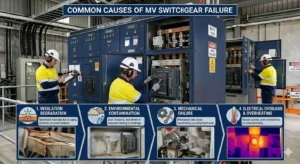
Common Causes of MV Switchgear Failure
If there isn’t regular medium voltage switchgear maintenance, many issues (mechanical, electrical and environmental) can result in failures and compromise the safety of a system.
- Insulation failures. Moisture, aging or contamination issues can weaken insulation.
- Overheating. Loose or overloaded connections can create excessive heat.
- Arc flash fault. Internal faults can cause conditions for an electrical arc.
- Mechanical failure. Frequently engaging moving components or breakers can cause significant damage to the system.
- Poor maintenance. More frequent inspections help reduce unexpected failures.
Risks caused by Negligence of switchgear preventive maintenance
Ignoring preventative medium voltage switchgear maintenance can cause serious safety and operational issues, as well as expensive equipment destruction.
- Issues can go unseen and lead to critical failures and breakdown
- Maintenance neglect can lead to catastrophic electrical issues and arc flash risks
- Connections that are damaged or loose will create hot spots and lead to overheating complications
- Diminished system reliability and outages interrupt consistent operation.
- Severe failures will damage major components and ultimately drive up repair costs.
Read More : Best Substation Transformer Manufacturers
Visual Inspection Checklist for Medium Voltage Enclosures.
Regular inspection of medium voltage enclosures will detect problems early, assure that equipment operates safely and reduce electrical switchgear maintenance costs.
- Observe enclosure integrity: Check for corrosion, cracking, and any physical damage
- Survey insulation surfaces: Look for presence of dirt and/or moisture, and areas of discoloration.
- Confirm connections: Look for unbroken and secure terminals and busbars.
- Verify absence of overheating: Look for marks of burning, and detect any unusual smells.
- Survey the enclosure’s seals and ventilation: Look for unbroken seals and establish that there is proper airflow.
How to choose the best switchgears
Selecting the right switchgear can guarantee safety, performance, and power distribution tailored to your use case.
- Assess voltage and current ratings: Switchgear should have adequate capacity.
- Confirm safety criteria: Look to see if it meets the IEC or IEEE.
- Analyze the protection: Assess quality fault and arc flash protection.
- Take into account the environment: Weather can influence switchgear decisions.
- Look at how it is maintained: Switchgear should be easy to reach for simple inspections.
Features of Beianelec’s Switchgears
Beianelec switchgears utilize internationally advanced technology for smart power distribution in industrial and commercial electrical systems and combine modern technology and quality standards for safety and reliability of power systems.
- IEC and ISO certified: Safe and quality products, manufactured in accordance with international production standards.
- Sophisticated protection systems: Reliable isolation of network faults with protection against electrical overloads.
- After sales services and helping clients making the medium voltage switchgear maintenance perfectly
- Broad assortment: Includes low and high voltage switchgear, as well as metal-enclosed switchgear.
- Sturdy design: Long lasting and safe, even in harsh industrial conditions.
- Personalized design: For specific requirements of voltage, use, and placement.
FAQs
What are the signs that my MV switchgear needs immediate maintenance?
Examples of these signs can be overheating, unusual noises, burning odors, discoloration of insulation, frequent tripping of breakers, builds up of moisture, visible corrosion, signs of arc flashes and abnormal readings during thermal inspections or thermal monitoring.
How often should Medium Voltage switchgear be maintained?
Routine switchgear maintenance and testing should be conducted between 6 months and 12 months, and testing and/or servicing performed every 2-5 years depending on the operating condition, load, and environment.