 Skip to content
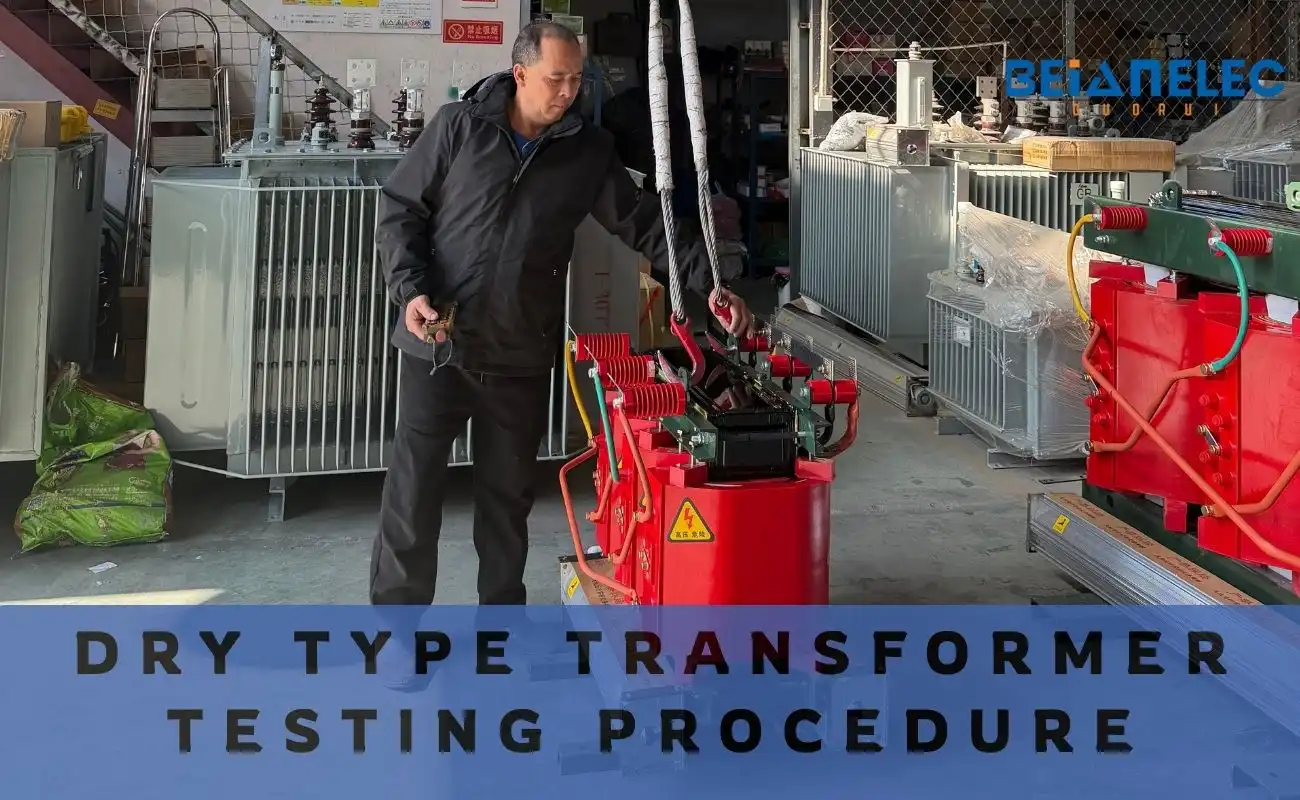
Before dry type transformers can be commissioned and put into service, it is vital to conduct dry transformer testing procedure to ensure their electrical performance, safety, and reliability. This is to ensure the safety of the transformer, obtain design testing compliances, and be able to operate within the international standards and safety regulations that come with the transformer’s rated conditions. Also distribution transformer testing procedure helps to identify any errors that may have occurred during the manufacturing process, any weak points in the insulation, or in the installation process. This reduces the risk of failure, improves efficiency, and ensures long dependable operation in industrial, commercial, and utility applications.
What is testing for dry type transformer ?
Dry type transformer testing procedure aims to ensure that the electrical integrity, insulation power, and overall performance of the transformer is reliable, and in accordance to set standards. This is to ensure that the set standards and regulations are sufficiently complied with and will confirm safe operation under the assigned rated conditions
- Long transformer insulation test, which ensures there is no damage or moisture present that would compromise the insulation of the transformer’s winding and ground.
- Winding resistance test which ensures that conductor connections are accurate, and no joints are loose, and checks for even current distribution.
- Turns ratio test to confirm correct voltage ratios and proper functioning of tap changers, where applicable.
- Applied voltage and induced voltage tests to validate insulation strength under normal and overvoltage conditions.
Read More: What is the function of oil in transformer ?
How many types of transformer testing ?
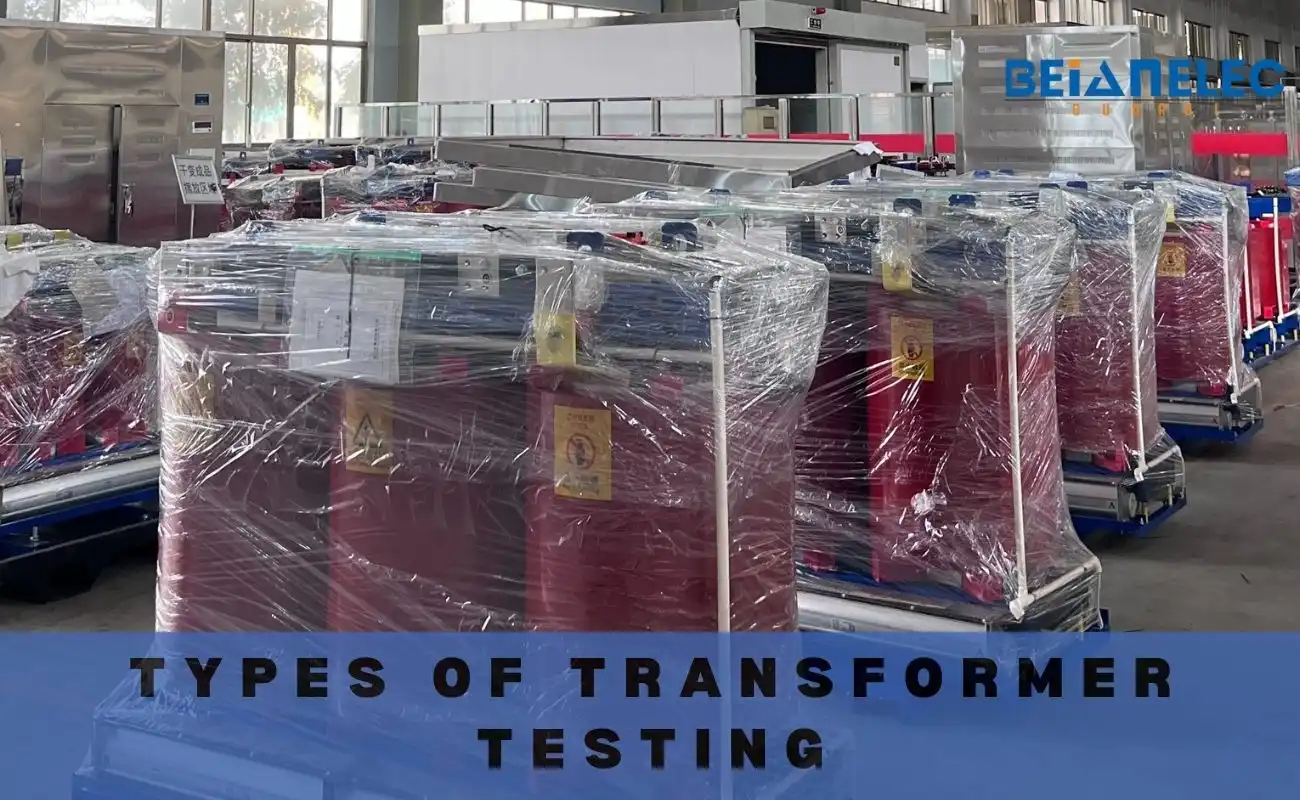
Testing transformers is important for assessing design reliability, manufacturing consistency, and operational safety and for assessing the above. Dry type transformer testing procedure is required to meet international standards, detect defects early, and confirm that the equipment will perform well under both normal and fault conditions.
- Routine tests will be done on every transformer to confirm the basic electrical specs of the transformer, like winding resistance, turns ratio, insulation resistance, and no-load and load losses.
- Type tests are done on a prototype design to assess if the design is within the bounds of the standards and to assess the thermal performance and dielectric strength, as well as the temperature rise.
- Special tests are done at the request of the customer or for needs of the project. Examples would be partial discharge testing and impulse voltage testing, sound level testing, and short-circuit withstand testing.
Read More: Discover the Guide of Transformer Clearance Requirements
Dry type transformer testing procedure
Procedures for dry transformer testing will always be carried out to ensure that dry type transformers are safe, efficient, and meet the necessary building code standards. These tests measure each transformer’s mechanical and electrical performance. Testing during the commissioning and operational phases helps to ensure efficient performance, modify transformer operation to correct failures, and help to maintain reliable performance in the dry type transformer’s various applications over an extended period.
- Confirm the condition and the integrity of the winding’s insulation and the ground, to check for any moisture or deterioration.
- Checking the turns ratio in order to ensure that the correct voltage has been transformed and that the tap changer is operational, if so.
- Over and under-voltage tested to assess the strength of the insulation of the test voltage.
- The mechanical and visual inspections are to help assess the physical condition and the clearances to help site the transformer before the power is turned on.
Advanced Diagnostics for Dry Type Transformers
Transformers of dry types are able to perform advanced diagnostics to help identify hidden faults, determine the quality of insulation, and predict failures that may occur in the future. These methods promote reliability, improve the planning of maintenance, and help to increase the life of the transformer while providing safe operation and efficient functioning.
- Transformer partial discharge test procedure in order to detect voids in the insulation that may break down and lead to surface discharges.
- The IR (infrared) method of thermography to detect a rise in temperature and identify areas that may present a cooling deficiency, all of which may be done without the need to take the transformer out of service.
- The method of analysis of frequency response to detect the presence of delaminations of the windings, or other alterations caused by mechanical transport or a short circuit of the core.
- The method of testing of the tilting (“tan”) factor or (“delta”) to measure the insulation loss and determine the degree of aging of the insulation.
- Monitoring of the emission of acoustics to determine the presence of internal discharge and mechanical vibration at the core of the transformer.
Safety and Environmental Classification Tests
Safety and environmental classification testing is undertaken to ensure that the transformer testing procedure meets the standardized testing services regarding fire, safety, and environmental performance. The tests are done to verify that the transformers are safe to use in sensitive areas, that the environmental footprint is negligible, and that international regulations and installation requirements are met.
- • Fire behavior tests are done to classify transformers regarding flame spread, self-extinguishing ability, and fire resistance to abnormal operating conditions.
- Smoke emission tests are done in order to evaluate the risk of personnel exposure during fire situations so that the smoke and other emissions are less dense and less toxic.
- Environmental class tests are done to verify that the transformers are performant in conditions of humidity, condensation, and pollution.
- Temperature tests and thermal class verification to ensure that the transformers are safe to operate and do not pose an environmental impact by operating within the insulation limits and having no other adverse impacts.
- The tests on the level of noise generated by the transformers are done to provide proof to the relevant authorities that the new regulations on environment and noise in the workplace are being complied with.
Winding Resistance Measurement Techniques at Ambient Temperature
In distribution transformer testing procedure, winding resistance measurement can be done at ambient temperature and represents the first level electrical test of the transformer windings. The main purpose of the test is to establish the electrical condition of the transformer windings. In addition to establishing the electrical condition, dry type transformer testing procedure verifies connections and manufacturing errors, and may help to identify problems such as loose joints and damaged conductors prior to the commissioning of the unit and during maintenance.
- Direct current (DC) resistance measurement is done using a micro-ohmmeter, which provides the most precise, sensitive, and repeatable values of winding resistance.
- The Kelvin four-wire technique is used to measure the windings at lower values of resistance and eliminates the resistance of the test leads and the contact points.
- The test intervals of the measurements are used to allow stabilization of the test current and the winding temperature for improved accuracy and repeatability of the measurements.
- Imbalance and measurement of winding values is used to determine deviation, which can be abnormal or symptomatic of winding faults of the unit, between the measured values of the winding resistance of the different phases.
- Measured values of resistance are adjusted for temperature to provide the most accurate comparisons to the data provided by the manufacturer and the historical information.
Comparison Between HV and LV Winding Resistance Testing
Understanding the differences in properties and behavior for high voltage transformer testing procedure and also for the low voltage helps us understand and assess the condition of the Transformer accurately.
- The high voltage transformer testing procedure has longer stabilization periods and higher resistance values due to higher levels of conductor length and inductance.
- The LV Winding Resistance Testing has lower values of resistance and requires very precise equipment to find small deviations.
- The HV windings are more affected by temperature, which makes temperature correction more of a consideration.
- The LV windings are more affected by the contact resistance and the quality of the connection, which suggests a more careful attention to the test lead
- Assessing imbalances and early detection of a loose connection and damaged windings by comparing phase-to-phase resistance of the HV and LV windings.
Why Beianelec Factory is considered the best transformer factory
Beianelec Factory stands out as a leading manufacturer of transformers because of their dedication to quality, innovation, and customer satisfaction.
- International standards are met because of their strict adherence to quality control at all levels of production, from raw materials to the testing of end products.
- Tailored transformer designs are developed by their engineering and technical teams to meet the specifications of a customer’s project and desired applications.
- The use of high-quality materials and parts improves electrical efficiency, heat performance, and prolongs overall durability.
- Their dependable performance and operational safety are a result of their extensive testing, such as routine, type, and special tests.
FAQs
What is the IEC standard for dry type transformers?
The IEC standard describing dry transformers is IEC 60076-11, which covers requirements related to design, testing, insulation, the temperature rise limit, environmental ratings, and fire safety. It is also regarded as the reference of dry type transformer testing procedure to achieve the best required factors
Why is the partial discharge test critical for dry type transformers?
The transformer partial discharge test procedure is one of the most important for dry-type transformers because it identifies problems related to insulation that could hinder or partially discharge, voids, or weak portions of the insulation. This preemptive insulation failure, low electrical fault, long-term reliable and safe operating transformer, and insulation failure risk.
