
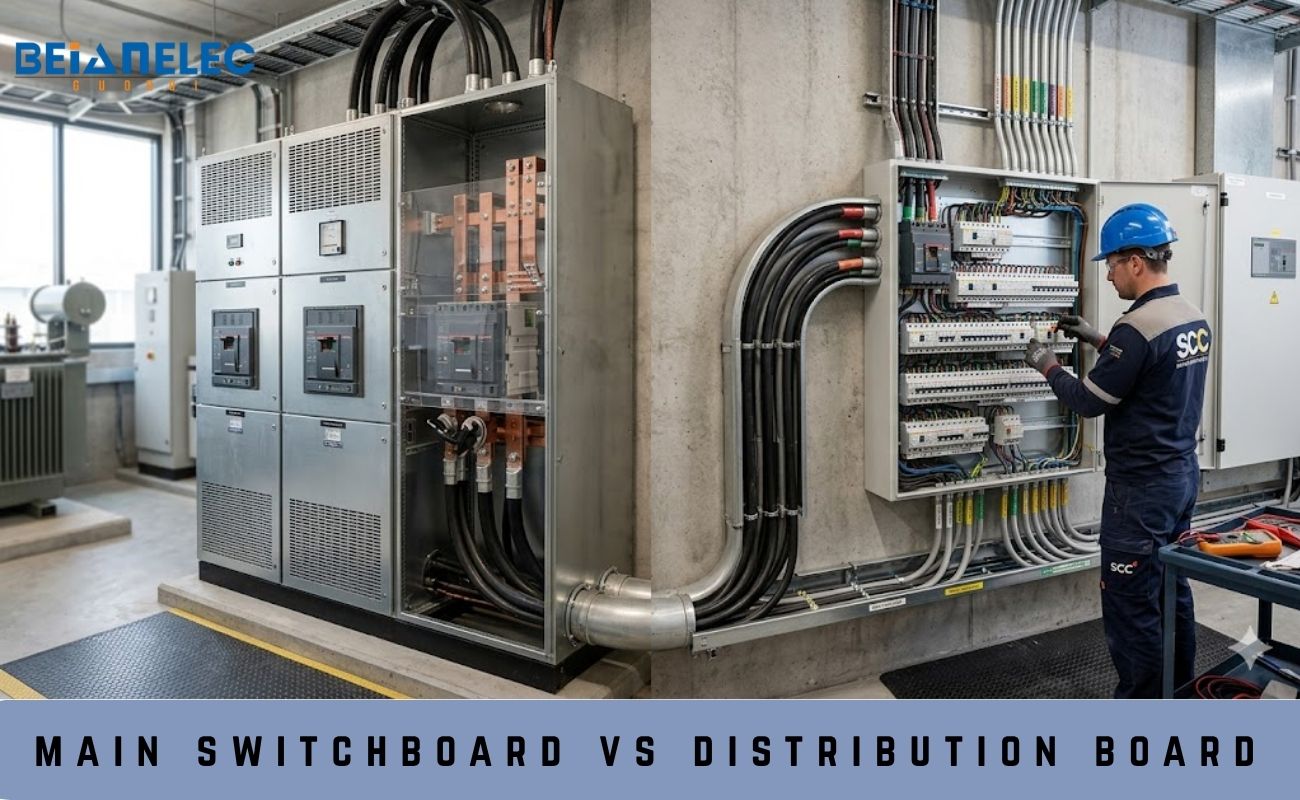
A main switchboard and a distribution board refer to different systems, and both are used in electrical power distribution systems. The main switchboard is a key component of the system, which collects power from the utility or a transformer and redistributes this power to sections of the system controls.
The distribution board receives power from the main switchboard and redistributes that power to a number of local circuits, loads, or sections of the building. There are many differences between main switchboard vs distribution board to be discussed in this article.
What is the Main Switchboard and its role ?
A main switchboard is an electrical distribution unit that collects incoming electrical supply, either generated on-site, supplied by a utility, or originating from a transformer, and redistributes it to various locations in a building or facility. This unit consists of a main circuit breaker, protection devices, and measurement and monitoring equipment and control devices.
A main switchboard’s primary function is to control, protect and supply electricity to downstream distribution boards and associated electrical loads. Because of these capabilities, a main switchboard enhances the reliability of the electrical system while providing protection from electrical faults and enabling isolation of the system from the supply for the purpose of maintenance and facilitating the safe use of the electrical system in commercial, industrial, and institutional environments.
What is the Distribution Board and its role ?
A distribution board (DB) is a type of electrical panel which collects supply from a main switchboard and gives the supply to various branch circuits. Containing a mix of circuit breakers, protective devices, busbars, etc., DBs allow flexibility, reliability, and protection against the overloading of circuits.
DBs primarily serve the purpose of safely supplying power to various pieces of equipment and electrical systems. The protection of circuits is a key feature, but the maintenance of DBs is promoted, along with a distribution of power that is safe and reliable, and all of this contributes to an improved operational safety. This is vital in residential, commercial and industrial activities.
Read More : Importance of Switchgear Preventive Maintenance Procedures
Key Differences Main Switchboard vs Distribution Board
There are many differences between main switchboard vs distribution board as the following:
| Feature | Main Switchboard (MSB) | Distribution Board (DB) |
| Function | Receives and distributes power from the main source | Distributes power to individual circuits and loads |
| Location | Installed at the main power entry point | Located closer to end-use areas |
| Capacity | Handles higher current and larger loads | Handles lower current and localized loads |
| Components | Main breakers, metering, protection, and control devices | Branch circuit breakers and protective devices |
| Role | Central power control and distribution | Local circuit distribution and protection |
Industrial uses main switchboard vs distribution board
The Main Switchboard are commonly used in the following cases:
- Power from Utility, Generator and Transformer is connected to the Main Switchboard.
- The Main Switchboard controls and provides protective devices for large and industrial electrical loads.
- Power is distributed to Distribution Boards via the Main Switchboard.
- On other hand, the Distribution Board is preferred for the following uses:
- Power is distributed to production lines, machines, work areas, etc. from the Distribution Board.
- The Distribution Board provides local circuit protection and fault isolation for the connected loads.
- The Distribution Board provides flexibility of operation and is designed to facilitate maintenance.
Read More : Electrical distribution switchgear systems from Beianelec
How to choose Distribution Board
Proper selection of a distribution board is essential for safe and reliable distribution of power as well as the optimal functioning of the electrical installations.
- Assess the load: The distribution board should be rated for the amount of current and power required.
- The distribution board should have adequate outgoing ways to cater for future circuit additions.
- It should be equipped with the relevant circuit breakers and protective devices.
- Assess the enclosure rating: The distribution board should have a suitable IP rating.
- Assess the standards: The distribution board should be compliant with world standards (IEC) and local standards.
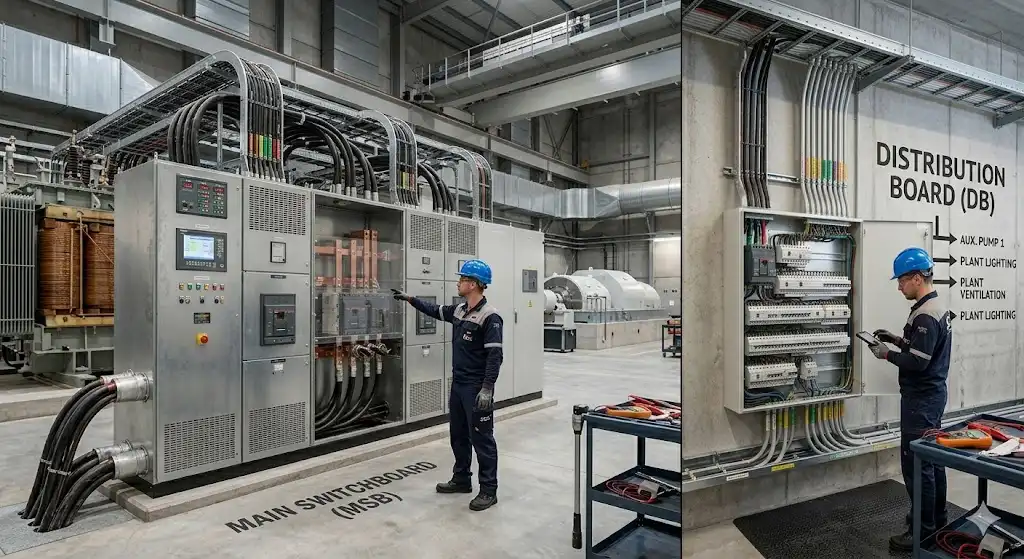
Industrial Applications of main switchboards vs distribution boards
Throughout industrial facilities, the main switchboard vs distribution board is imperative to the effective management of power.
Main switchboards take in power from utility networks, control the distribution of power to the various sections of the plant, and safeguard key industrial equipment from electrical faults
Distribution boards deliver power to production and industrial equipment, allocate power to lighting, HVAC, and auxiliary services, and supply localized protection and maintenance for circuits.
Read More : Top Switchgear manufacturers in China
Why to choose Beianelec factory for switchgears ?
Beianelec manufactures switchgear to safely and reliably handle power distribution within commercial and industrial environments. Our switchgear worldwide provides safety and integrity. Also we focus on features of both main distribution panel vs switchboard while serving our clients needs
- State-of-the-art manufacturing facilities: Flexible manufacturing with next generation production capabilities and tight quality controls.
- Compliance with international standards: All products are designed with IEC in mind.
- Complete product coverage: Our range extends through low, medium, and high voltage switchgear.
- Flexible engineering: Designs are modified to accommodate the requirements and specifications of individual projects.
- Comprehensive quality assurance: Every switchgear is rigorously tested in the factory.
- Assured performance: Designed to operate for the long term in harsh conditions.
- Smart technology integration: Provides support of monitoring, automation and advanced control.
- Technical professional support: Supplies services and expertise before and after project execution.